Microwave minutes are the longest minutes.
There’s no doubt about this.
You slide your favorite food in and set the timer.
Great.
But now comes the tough part.
It lights up and illuminates the food.
Enticing you.
It spins smoothly,
Showing you all the delicious angles.
Taunting you.
The food warms, sizzles, and pops.
Calling to you.
But wait, it’s not done.
You still have a few more minutes to go.
So you stare at the food,
At the delicious food inches from you,
You and your growling stomach.
The timer ticks down.
Slowly. Slower. Slowest.
You’re convinced that you’re going to be ninety by the time it’s done.
Or at the very least not hungry anymore.
And yet it still spins and cooks and laughs
Blatantly in your face.
Ha. Ha. Ha.
Until finally, finally
You hear that ding of the microwave.
It sounds like a heavenly choir.
So you open the door,
Test it with your finger.
And…disappointment.
It’s still cold.
You sigh and close the door,
Punching in more numbers.
It spins again, showing off.
And again you wait.
And wait…
And wait…
And wait…
Microwave minutes are the longest minutes.
Written by Taylor Neal.
Showing posts with label Writing. Show all posts
Showing posts with label Writing. Show all posts
Thursday, May 3, 2012

Monday, April 16, 2012
Another Reason to Eat Healthy…That You May Not Have Thought Of

Image source: here.
We’ve all heard the reasons to eat
healthy, Do it for your heart, You’ll regret it later, Set a good example. But there’s one
that’s often forgotten about, and if you’re a Christian, it should probably be
the first reason you turn to.
Our
bodies don’t belong to us. They belong to God.
1 Corinthians 6:19-20 says:
Or do you not know your body is a temple of
the Holy Spirit within you, whom you
have from God? You are
not your own, for you were bought with a price. So
glorify God in your
body.
ESV
Now, if you’re like me, this verse
is the last thing you’re thinking about when you’re at the grocery store and
that box of garlic bread jumps out at you, begging to be bought. But this
should change. Our bodies are a gift.
Let’s look at it this way. Your best
friend has a birthday coming up, and they always get you really nice gifts on
your special day, not to mention they’ve always been there for you when you
needed them. So, are you going to return the favor and try to get your best
friend something you know they’ll love, or are you going to wrap up that candy
dish you broke last week?
I don’t know about you, but the
broken candy dish wouldn’t be the first thing I turned to. But when we fill our
bodies with junk food and unhealthy crap, are we not giving God, who gave us
the greatest gift of all—life—that broken candy dish? Are we not taking the
easy way out and giving Him less than He deserves?
I’m not saying I eat healthy, in
fact, I don’t. My latest purchase was a greasy pizza. But I use to.
About six months ago I went to a
dietician because I knew my diet was the absolute opposite of healthy. Turns
out, it was actually worse than I thought, filled with enough fat to give me a
heart attack within 20 years. Not great news for a college student. So,
together we worked out a plan that would fit my picky eating style and my
body’s nutritional needs.
It went great at first. I went all
in, actually spending time looking at the nutrition labels and trying to decide
what would be best instead of simply being drawn by the bright colors and what
sounded good.
And then I cheated. I let myself
have that pizza I had been craving.
(Let me say here, there’s nothing
wrong with a few unhealthy foods every once in awhile as long as the majority
of your choices are healthy).
But the problem wasn’t that one
cheat, it was the growing number of them that came after. Within a few weeks my
diet was back to how it had been before I had seen the nutritionist, and that’s
how it remains.
And I’ve been feeling guilty. This
junk I’ve been feeding my body is in no way serving God for all of the amazing
blessings he’s given me. I want to serve Him in every aspect of my life. I want
to glorify Him through taking care of myself.
I want to find something better to
give Him than that broken candy dish.
So, here it is, a recommitment. To
eating healthy. To making better choices. But mostly, to serving a God who has
given me the greatest gift I could have asked for—life.
Care to join me? You don’t have to
be perfect, and you don’t have to completely give up that chocolate cake you
love. Just start with one tiny aspect. Drink milk instead soft drinks. Try a
new vegetable. But most importantly, just try. Try serving God in a new way, a
healthy way.
Here’s to eating healthy. Not for
us, but for Him.
Written by Taylor Neal.
*This blog doesn't own the image above.
Wednesday, April 4, 2012
Styled to Perfection

Image source here.
And just like the perfect person doesn’t exist, neither does the perfect food, which is why food stylists have their own tricks to achieve that flawless image.
As adults, we know that advertising is simply that, advertising only meant to entice, not necessarily to depict the exact product. We expect a little variation in what actually comes out of the box, but what about kids, who expect this perfection they see? The American Psychological Association claims that children under eight years old regard every advertisement as truthful and accurate, as they are unable to critically understand them.
Food styling, as we know it today dates back to around the 1950s were the employers were exclusively women with degrees in home economics. Before the 1950s many food advertisements were hand drawn, so when the trend shifted to photography, many of these women began working for advertising companies where they taught themselves the tools needed in this new profession. As with any new career, these food stylists experienced problems in the beginning, having to deal with everything from refrigerators not opening to hot lights melting ice cream and wilting lettuce. However, these women were able to creatively overcome all of these problems and train the next generation, thus establishing a career choice for decades to come.
Since the 1950s, the industry of food styling has certainly changed. Vegan Soapbox says, “In 1995, the editor of Vegetarian Times magazine explained how the publication always photographs real food from real recipes, despite criticism that the photos weren’t the high quality that readers expected… They take photos without using fake food. They make a recipe and take a photo and that’s that. ‘In fact, when the photo shoot is over we often eat the food.’”
Vegan Soapbox also says that the editor was shocked when she realized the extreme things food stylists did to the food.

We’ve all seen the kid clinging desperately to a cereal box like Post Fruity Pebbles, begging their mom to buy it, (perhaps simply for the bright colors and prize depicted on the package) promising that they’ll eat it. And we’ve all seen the mom give in, sick of hearing the pleas. In advertising, this is called the “nag factor”. On the Random Facts website, an article detailing 55 random facts about advertising mentions that children ages 12 to 17 will “nag” their parent for a product on average about nine times until the parent finally gives in.

Image source here.
Another cereal that might fool kids is Cinnamon Toast Crunch. On the older version of the cereal box, a giant spoon is the focal point, filled with flawless cereal squares each having the cinnamon swirls in exactly the same place. The box even claims that this cereal has “a taste you can see.”
Food stylist and blogger, Kristian Walker, goes into detail about how she creates that perfect bowl of cereal that’s so often seen. First, she says, several boxes of cereal are dumped onto flat baking sheetes, and then, tweezers are used, so the pieces don’t become damaged, to pick out the most perfect ones (usually only about 50 to 60 pieces). Then, Crisco is put in the bowl until it is 2/3 full. Using the tweezers again, each cereal piece is individual placed around the dome to create the illusion of a large bowl of cereal. Wild Root Hair Tonic, which simulates milk, fills in any gaps.
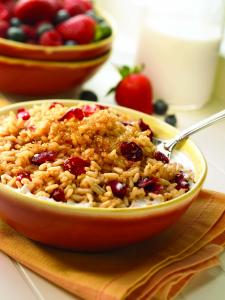
Another problem with the cereals mentioned above is that they are loaded with sugar and other unhealthy ingredients. For example, Post Fruity Pebbles cereal contains 12 grams of sugar in ¾ cup of cereal, and according to the American Heart Association website, a child should consume about 25 grams of sugar a day. While the better choices such as a banana or apple sauce may contain more sugar, they also provide more of a variety of healthy nutrients. However, they don’t receive all of the bright colors and advertisement attention that other products do.
Healthier cereals such as Kashi Go Lean Crunch are advertised to appeal to adults. While they feature the perfect pieces like the kids’ cereals, the colors only pertain to the food itself, not necessarily to the addition of cartoon characters. The problem with this is that good eating habits begin in childhood, and if children are more drawn to unhealthy choices when they are young, this habit will most likely continue into adulthood. But the bizarre set ups don’t just stop with cereal.

Image source here.
If a food stylist is staging a chicken, a sewing kit might come in handy in order to pin the skin extra tight, after washing the food with dishwashing soap, of course. Now, don’t forget the blowtorch and brown coloring, used to give it that extra golden brown glow.
PBS Kids Go is trying to offset kids’ false beliefs that every advertisement is accurate. On the website, there is a classroom activity that teaches kids ways that advertising companies make food look appealing and exactly what a food stylist does. The site includes the question, “What do cotton swabs, tweezers, glue, glycerin, oil and blowtorches have in common?” Answer: “They're all tools used by food stylists to make the food in print ads and TV commercials look appetizing.” It also has the quote from The Guardian, Tricks of the Trade, “I always say my job is to get the customer to buy the product just once — to make them feel like eating. If the food tastes revolting, then that's the manufacturer's problem. Anything is possible — if you have the time. If I was doing a commercial burger shoot, I would ask for around 400 buns and go through them all to find the perfect specimen.”

Image source here.
More good news for educating kids lies in the fact that the food can’t be all fake. “If a photo is destined to become part of an ad campaign, rules require the actual food product to be the “real thing,” explains Haje Jan Kamps in the food blog post The Dirty Tricks of Food Photographers. Kristian Walker, a food stylist and blogger at Right Brain, Left Field agrees, “Barbasol shaving cream holds up better than whipped cream for a photo shoot. Unless the whipped cream product is what is being advertised, that is. Then you have to use the real thing.”
By teaching kids about food stylists, they, as well as adults, can learn the exact tricks used to make food look appealing.
However, being a food stylist isn’t seen as dishonest. Instead, it’s seen as an art form. Above all, it’s about getting that perfect picture, much like any photographer strives for. The only difference is the medium.
On the forum, ForumHealthCare.org, a member with the screen name, wynwode, describes it well:
“It’s a little bit like women who use makeup to achieve an un-made-up look: not to fool, but just to compensate for the difficulties in looking good under less-than-perfect conditions.”
This relates back to the history of food styling in which the women had to deal with the difficulties of wilting lettuce and melting ice cream. They overcame it by being creative, a main trait for any food stylist.

Image source here.
Written by Taylor Neal.
*This blog doesn't own the images above.
Subscribe to:
Posts (Atom)